Total Pageviews

Wednesday, 13 November 2013

You can make your computer display "stealth": really? :) :D

An additional layer of security can be added to your computer. Sometimes it can be beyond your imagination. But still its amazing and fun to do such a master piece of security. :D :) 

Your LCD computer display can be provided with an extra security by following the lead of Brusspup, a well-known online illusionist and computer artist. You have to just remove your display's outer polarizing filter, and use polarizing sun glasses to view your display. It easy....right... :D :) 
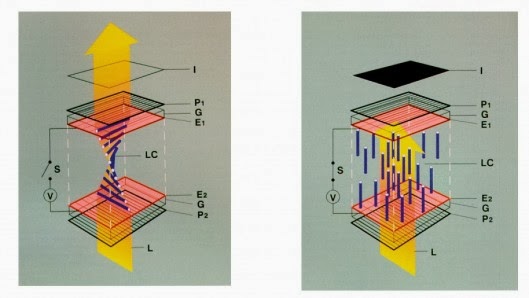
without voltage and with voltage
An LCD display depends on liquid crystals that can rotate the polarization axis of light as it passes through. In fact LCD pixels are made up of numerous layers, a pair of linear polarizers and a thickness of nematic liquid crystal with transparent electrodes that can apply a voltage across the liquid crystal. What happens when a voltage is applied? the voltage causes the liquid crystal's rodlike molecules to line up with applied field. In that configuration there is no structure to alter the polarization of the light, so that light leaving the liquid crystal is still horizontally polarized. This light cannot pass through the vertical polarizer P1, so this appears as a dark pixel. Based on the voltage level, the pixel can let any amount of light pass through, from bright to dark. At the same time without voltage, the light is polarized horizontally by horizontal polarizer P2, then passes through a liquid crystal LC. The thickness of the liquid crystal is set to that it rotates the polarization of the light by 90 degrees. This converts the horizontally polarized light leaving polarizer P2 into vertically polarized light ready to enter vertical polarizer P1. Finally light passes through P1 and appears as a bright pixel. 

Brusspup who is also specialized in optical illusion noticed that if you completely remove polarizer P1, an LCD display shows uniform illumination with a varying pattern of polarization over the screen. However, our human eye is not very sensitive to the polarization of light with which it sees the world. The same way you might feel the LCD display to be bright and featureless when the final polarizing film of the display is removed. 

It means if you wear vertical polarizing filters over your eyes, you will see the original image and image is not visible to anyone else who is not wearing polarizing glasses. Interesting!! isn't it? Now you try at home... :) 

Its gives you a stealth display and added security along with fun too.... :D :) 

                                              Check out this video


Tuesday, 12 November 2013

Surfaces that cool before you think: From MIT

MIT researchers have come up with a way to cool hot surfaces more effectively by keeping droplets from bouncing. 

When an earthquake and tsunami struck Japan's Fukushima nucleur power plant in 2001, knocking out everything on the way, crews tried to spray seawater on the reactors. But everything was in vein. One possible reason can be droplets not able to fall or land on surfaces that are hot. Because they instantly begin to evaporate, forming a thin layer of vapour and then bouncing along it, juts as they would in a hot cooking pan. 

But now, MIT has come up with a new solution. Their solution is, decorate the surface with tiny structures and then coat it with particles about 100 times smaller. Using that approach, they produced textured surfaces that could be heated to temperatures at least 100 degrees Celsius higher than smooth ones before droplets bounced. 

"Our new understanding of the physics involved can help people design textured surfaces for enhanced cooling in many types of systems, improving both safety and performance," says Kripa Varansai, the Doherty Associate Professor of Ocean Utilization in MIT's Department of Mechanical Engineering and the lead author of the study. Their research was to find a way to increase the temperature at which water droplets start bouncing. Past research indicated tough materials would add more surface area to hold onto droplets, making it harder to them to bounce. But the research team discovered that not just any rough surface will do. They found that installing microscale silicon posts on a silicon surface raised the temperature at which droplets transitioned from landing to bouncing. But it worked best when the posts were relatively diffuse. As the posts got closer together, the transition temperature gradually dropped until it was no higher than that of a smooth surface. 

"The result was surprising," says Bird, who is now assistant professor of mechanical engineering at Boston University. "Common knowledge suggests that the closely spaced posts would provide greater surface are, so would hold onto the droplets to a higher temperature." 

Upon further analysis the researchers concluded that closely spaced posts do provide more surface area to anchor the droplets, but they also keep the vapour that forms from flowing. Trapped by adjacent posts, the accumulating vapour layer under a droplet builds up pressure, pushing the droplet off. When the force of the vapour exceeds the attractive force of the surface, the droplet starts to float. "Bringing the posts closer together increases surface interactions, but it also increases resistance to the vapour leaving," says Varanasi. 

Experiments confirmed their approach. when they sprayed water on their micro-nano surfaces at 400 degree Celsius (the highest temperature their experimental setup could provide), the droplets quickly wet the surfaces and boiled. Interestingly under the same conditions the droplets did not wet the surfaces of samples with either the microscale posts or nanoscale texture, but did wet the surfaces of samples with both. 

In addition to the nuclear systems, this work has a lot of future applications for steam generators, industrial boilers, fire suppression etc. The research was supported by a Young Faculty Award from the Defence Advanced Research Projects Agency, the MIT Energy Initiative and the MIT-Deshpande Centre. 
Micrographs  showing water droplets landing on specially designed silicon surfaces at different temperatures.
At higher temperatures, the droplets begin to exhibit a new behaviour" instead of boiling, they bounce on a layer of vapour, never really wetting and cooling the surface. At 400 degree Celsius the droplet continues to boil only on the surface  that combines microscale posts with a coating of nanoscale particles (last column). These results demonstrate that this micro-nano surface can be effectively cooled even at high temperatures.

We must appreciate this DJ: Making the word "Impossible" to "Possible"


Intel IQ have started a unique 'Creative Technology Series' where they interview artists with extraordinary talents, whom use 'tech' in an extra ordinary way. In this series we can see how people overcome their limits and enhance creativity. While I was going through the series I came to notice a talent who had overcome his limits through an extra ordinary skill. 

'Robbie Wilde' is a deaf DJ. He has been working on his craft for about 10 years. He lost hearing at the age of 7 due to ear infections and is completely deaf in his right ear, while 80% deaf in his left ear. Starkey Hearing Foundation had sponsored him with an hearing aid, and he also communicates through reading lips. His love for music was born with him. His dad had a great love for beat. And hence his home was filled with music. But for Robbie, it wasn't easy. But still he tried to listen to his love the way he could. His parents were his inspiration. They taught him to give always 110%  and to move ahead in his life. 

I know, you will be having a question about how Robbie challenged his limits. What made him so special? Robbie's ability to play music in 'open format' which is an electric, difficult combination of different genres made him special. He had a partnership with SubPac, a backpack-like device that sends out just bass frequencies into your back without all the other noise. You can get a perfect feel for a song with it. Its like headphones for the deaf community, and when hearing people use it without headphones they get to experience music as Robbie feel always. 


When mixing and performing, he used a program called Serrato because the waveforms, the images of the sound, are colored. This allows him to separate the vocals, which he cannot hear, from the bass and instrumental parts. These visuals substitute for his hearing. This technology has definitely helped him to upgrade his skill and talents. 

See how Robbie used 'tech' for his life and taste. His philosophy is, whatever the new gadgets and software that come out, think outside the box and go beyond what it was built for. I think there is a lot to learn from Robbie Wilde, one of the best DJs. :) :D 


A synaptic transistor that learns while it computes


Material scientists at the Harvard School of Engineering and Applied Sciences (SEAS) have now created a new type of transistor that mimics the behaviour of a synapse. The  device simultaneously modulates the flow of information in a circuit and physically adapts to changing signals. We do have a lot of undiscovered as well as unusual properties in modern materials. The synaptic transistor could mark the beginning of a new kind of artificial intelligence: one embedded not in smart algorithms but in the very architecture of a computer. 

"There's extraordinary interest in building energy-efficient electronics these days," says principal investigator Shriram Ramanathan, associate professor of materials science at Harvard SEAS. "Historically, peole have been focused on speed, but with speed comes the penalty of power dissipation. With electronics becoming more and more powerful and ubiquitous, you could have a huge impact by cutting down the amount of energy they consume." 

The human mind, for all its phenomenal computing power, runs on roughly 20 watts of energy, so it offers a natural model for engineers. "The transistor we have demonstrated is really an analog to the synapse in our brains," says co-lead author Jian Shi, a postdoctoral felllow at SEAS. "each time a neuron initiates an action and another neuron reacts, the synapse between them increases the strength of its connection. And the faster neurons spike each time, the stronger the synaptic connection. Essentially, it memorizes the action between the neurons." 

In principle, a system integrating millions of tiny synaptic transistors and neuron terminals could take parallel computing into a new era of ultra-efficient high performance. 

So how does a synaptic transistor works? The synaptic transistor has a structure which is almost similar to that of a field effect transistor, where a bit of ionic liquid takes the place of the gate insulating layer between the gate electrode and the conducting channel, and that channel is composed of samarium nickelate (SmNiO3 or SNO) rather than field effect transistor's doped silicon. 

A synaptic transistor has an immediate response and a learning response. The immediate response is basically same as that of a field effect transistor- the amount of current that passes between the source and drain contacts varies with the amount of voltage applied to the gate electrode. The learning response is that the conductivity of the SNO layer varies in response to the STDP history of the synaptic transistor, essentially by shutting oxygen ions between the SNO and the ionic liquid. 

The electrical analog of strengthening a synapse is to increase the conductivity of the SNO, which essentially increases the gain of the synaptic transistor. Similarly, weakening a synapse is analogous to decreasing the electrical conductivity of the SNO. thereby lowering the gain. The artificial synapses have the flexibility to learn "more or less" how to perform a task, and then to learn how to improve its earlier performance etc. While the physical structure of Harvard's synaptic transistor has the potential t learn from history, in itself it contains no way to bias the transistor so as to properly control SNO's memory effect. This function is carried out by an external supervisory circuit that converts the time delay between input and output into a voltage applied to the ionic liquid that either drives ions into the SNO or removes them. In response, the synaptic transistors become self-optimizing within a circuit being subjected to learning experiences. 

The new transistor is inherently energy efficient. The nickelate belongs to an unusual class of materials, called corelated electron systems, that can undergo an insulator-metal transition. At a certain temperature when exposed to an external field the conductance of the material suddenly changes. "We exploit the extreme sensitivity of this material," says Ramanathan. "A very small excitation allows you to get a large signal, so the input energy required to drive this switching is potentially very small. That could translate into a large boost for energy efficiency." The beauty of this type of a device is that the 'learning behaviour is more or less temperature insensitive, that's a big advantage," says Ramanathan. 

The research was supported by the National Science Foundation (NSF), the Army Research Office's Multidisciplinary University Research Initiative, and the Air Force Office of Scientific Research. The team has also benefited from the facilities at the Harvard Centre for Nanoscale Systems, a memeber of the NSF-supported National Nanotechnology Infrastructure Network. 
Monday, 11 November 2013

Ink-Based Circuits on the way


Researchers from Georgia Tech, University of Tokyo and Microsoft Research have developed a novel method to rapidly make electrical circuits by printing them with inkjet printers and off-the-shelf materials. This may in turn reduce the fraction of time and cost. A wonderful idea isn't? :) :D 

The technique called instant-inkjet circuits, allows the printing of arbitrary-shaped conductors onto rigid or flexible materials and could advance the prototyping skills of non-technical enthusiasts and novice hackers. "We believe there is an opportunity to introduce a new approach to the rapid prototyping of fully custom-printed circuits," said Gregory Abowd, Regents' Professor in the School of Interactive Computing at Georgia Tech and an investigator in the study. "Unlike existing methods for printing conductive patterns, conductivity in our technique emerged within a few seconds and without the need for special equipment." 

We know that there are a lot of advancements in the field of nano engineering. Researches have used the latest advancements in chemically bonding metal particles to their concept. They used silver nanoparticle ink to print the circuits and avoid thermal boding, or sintering, a time-consuming and potentially damaging technique due to the heat.  Printing the circuits on resin-coated paper, PET film and glossy photo worked best. Researchers also made a list of materials to avoid, such as canvas cloths and magnet sheets. 

"Everything we introduced in our research is available in the market and makes it possible for people to try this at home," said Yoshihiro Kawahara, Associate Professor at the University of Tokyo and the primary investigator who developed the methodology while in Atlanta. "This method can be used to print circuit boards, sensors and antennas with little coat, and it opens up many new opportunities." 

Once printed, the circuits can be attached to electronic components using conductive double-sided tape or silver epoxy adhesive, allowing full-scale prototyping in mere hours. The home made circuits might allow tinkerers to quickly prototype crude calculators, thermostat controls, battery chargers or any number of electronic devices. "Using this technology in the class room, it would be possible to introduce students to basic electronic principles very cheaply, and they could use a range of electronic components to augment the experience," said Steve Hodges, a team member from Microsoft Research. 


Inkjet circuits can be used for a wide range of applications: 

  • Rapid prototyping electronic circuits
  • Inter-digitated capacitive touch sensing: Capacitive touch sensing has become an important way of detecting touch-based interaction between a user and all manner of digital devices. Using inkjet printing technology, we can fabricate uniquely shaped capacitive sensing electrodes which are optimized for a particular application. 
  •  For manufacturing Printed antennas: An antenna is an electronic component that converts electrical energy into electromagnetic radiation in the form of radio waves and vice-versa.
A lot of researches are currently going on, which include a combination of inkjet printing and laser cutting. Hence we are looking for a future where we can develop 3D prototypes etc. All I can say is, this invention can bring a lot of advancements in the field of Electronics and I cant wait to see the magic of Inkjet printing technology. :) :D